
Inside Sudan’s Alleged Chlorine Weapons Program: New Evidence Raises Questions Over Military Leadership
Inside Sudan’s Alleged Chlorine Weapons Program: New Evidence Raises Questions Over Military Leadership
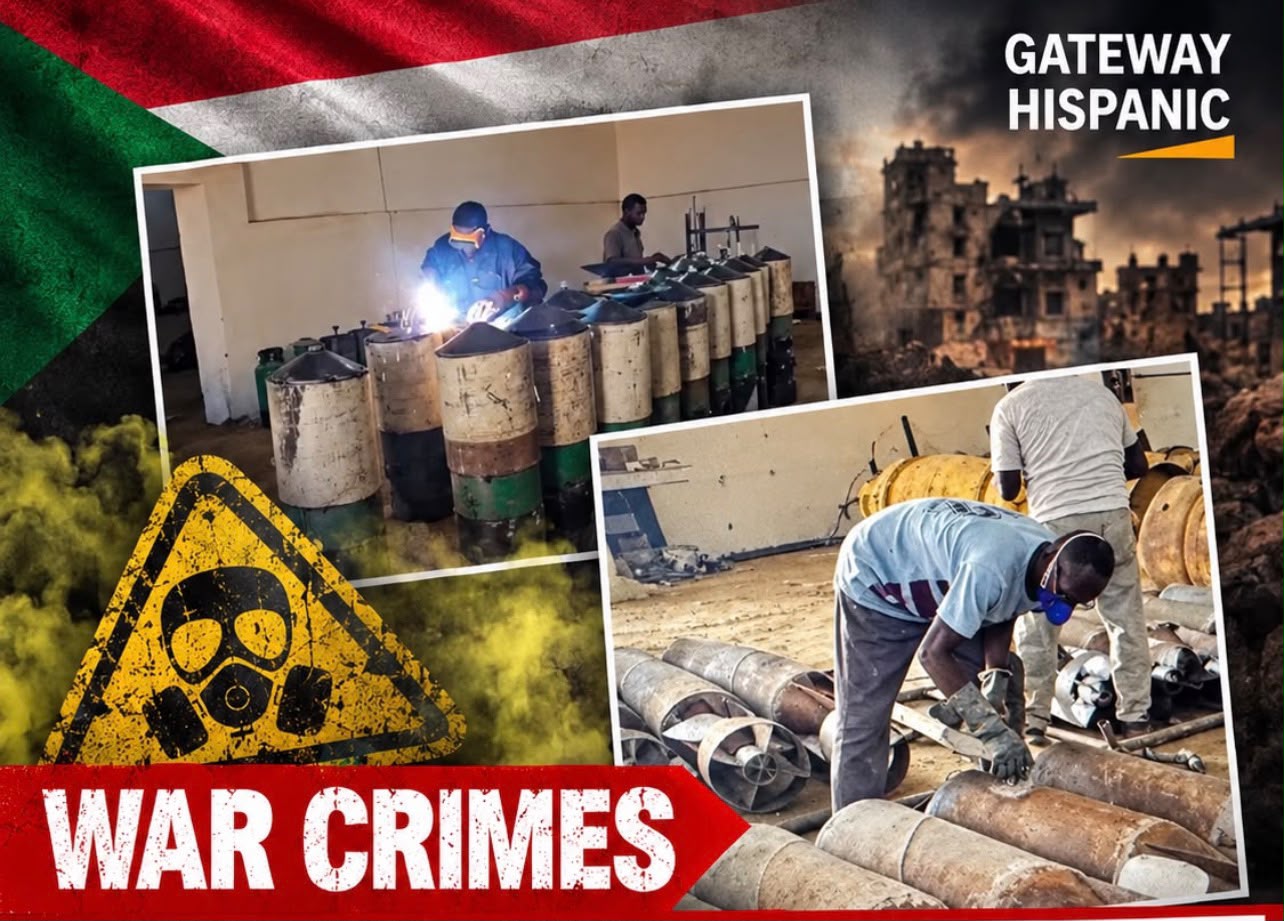
A newly disclosed intelligence dossier is providing the most detailed evidence yet of an alleged secret chemical weapons program operated by Sudan’s military during the country’s devastating civil war.
The dossier contains military documents, photographs, videos, voice recordings and intercepted messages that appear to show the Sudanese Armed Forces (SAF) developing, testing, producing and stockpiling chlorine-based weapons in 2024.
The evidence reportedly points to the involvement of senior SAF officers and raises questions about the knowledge of Gen. Abdel Fattah al-Burhan, Sudan’s military chief and de facto leader.
According to the documents, Brig. Gen. Tariq Hussain oversaw the alleged program. In July 2024, he reportedly proposed weaponizing chlorine as SAF forces battled the Rapid Support Forces (RSF) around Khartoum.
The weapons were reportedly designed to combine approximately 15 kilograms of chlorine gas with explosives, allowing them to cause both blast and toxic effects.
Videos examined by investigators reportedly show desert tests in July 2024, including a test launched from Merowe Airport. By October, nearly 300 chemical munitions had allegedly been produced, with hundreds stored at Merowe. One intercepted message indicated that 106 had already been used, although the exact number cannot be independently confirmed.
The dossier also raises concerns about the source of the chlorine. Some supplies were reportedly imported, including cylinders from Egypt, while other material may have been diverted from civilian water-treatment facilities.
Organizations including UNICEF, CARE and the International Committee of the Red Cross had supplied chlorine for water purification during the war. UNICEF has said it has no record that its supplies were diverted or misused and emphasized that the material was provided exclusively to make drinking water safe.
The allegations are particularly significant because the United States had already determined that Sudan’s government used chemical weapons in 2024. Washington subsequently imposed sanctions connected to the alleged use.
The newly disclosed material appears to provide additional evidence behind those earlier U.S. conclusions. It reportedly includes communications suggesting that senior military officials sought to eliminate evidence of the program after the U.S. sanctions.
One intercepted communication allegedly instructed officials to remove “all traces” of the operation.
Sudan’s military has rejected the allegations as baseless. Experts who reviewed the material have cautioned that definitive confirmation would require an independent investigation and physical access to suspected sites inside Sudan.
The alleged use of chlorine weapons would constitute a serious violation of the Chemical Weapons Convention, to which Sudan is a party.
The Sudanese Armed Forces, Rapid Support Forces, and the Civil War
The current conflict pits the Sudanese Armed Forces (SAF) against the Rapid Support Forces (RSF), two former allies whose struggle for power has devastated the country since April 2023.
The Sudanese Armed Forces are Sudan’s official national military. Their modern institutional roots trace back to the Sudan Defence Force, established under British colonial rule in 1925. After independence in 1956, the force evolved into the national army.
Under the long rule of Omar al-Bashir (1989–2019), the SAF was a central pillar of the Islamist-leaning regime.
Gen. Abdel Fattah al-Burhan rose through its ranks, including service in Darfur, and eventually became its commander. Following Bashir’s ouster, al-Burhan led the military component of the transitional arrangements and later became head of the SAF-aligned government, now based primarily in Port Sudan.
The Rapid Support Forces originated as a formalized paramilitary force in 2013 under Bashir. They grew out of the Janjaweed Arab tribal militias that the government armed and deployed during the Darfur conflict in the early 2000s to suppress mainly non-Arab rebel groups.
Those earlier campaigns involved widespread atrocities widely described as amounting to genocide or ethnic cleansing.
The force expanded through state support, gold-mining revenues in Darfur, foreign deployments—including as mercenaries in Yemen—and recruitment that later included fighters from neighboring countries.
By the final years of Bashir’s rule, the RSF had become a powerful parallel security force.
In 2019, popular protests toppled Bashir. The SAF under al-Burhan and the RSF under Hemedti jointly seized power and initially shared authority in a transitional Sovereign Council, with al-Burhan as chairman and Hemedti as deputy, alongside civilian representatives.
They cooperated again during the October 2021 military coup that dissolved the civilian-led government.
Tensions subsequently escalated over the planned integration of the RSF into the regular army as part of a transition toward civilian rule, as well as disputes over control of resources and political power.
Fighting erupted in Khartoum on April 15, 2023. Each side has accused the other of firing first.
What began as urban combat in the capital rapidly spread across the country.
The war has produced one of the world’s worst humanitarian crises.
Estimates of total deaths vary widely due to undercounting and indirect causes such as disease and starvation. Recorded direct fatalities from violence exceed 50,000 according to some trackers, while higher estimates of overall deaths reach into the hundreds of thousands.
Millions have been displaced. Internal displacement approached 11–12 million at its peak, with roughly 9 million internally displaced and several million more refugees in neighboring countries, according to 2026 data, alongside significant returns in some areas.
Widespread famine, destruction of infrastructure, and atrocities have been documented on both sides.
Foreign actors have fueled the conflict through arms, funding, and other forms of support.
The SAF maintains operational and political ties to Islamist networks, including groups associated with the Sudanese Muslim Brotherhood, or Sudanese Islamic Movement, and remnants of the former Bashir-era regime.
These include auxiliary forces such as the Al-Baraa ibn Malik Brigade, which has fought alongside the SAF.
Analysts describe the relationship as a tactical or strategic alliance that has provided fighters and support, although al-Burhan has publicly rejected claims that Islamists control the army.
The dossier also raises concerns about the source of the chlorine
Some supplies were reportedly imported, including cylinders from Egypt, while other material may have been diverted from civilian water-treatment facilities.
Organizations including UNICEF, CARE and the International Committee of the Red Cross had supplied chlorine for water purification during the war. UNICEF has said it has no record that its supplies were diverted or misused and emphasized that the material was provided exclusively to make drinking water safe.
The allegations are particularly significant because the United States had already determined that Sudan’s government used chemical weapons in 2024. Washington subsequently imposed sanctions connected to the alleged use.
The newly disclosed material appears to provide additional evidence behind those earlier U.S. conclusions. It reportedly includes communications suggesting that senior military officials sought to eliminate evidence of the program after the U.S. sanctions.
One intercepted communication allegedly instructed officials to remove “all traces” of the operation.
Sudan’s military has rejected the allegations as baseless. Experts who reviewed the material have cautioned that definitive confirmation would require an independent investigation and physical access to suspected sites inside Sudan.
The alleged use of chlorine weapons would constitute a serious violation of the Chemical Weapons Convention, to which Sudan is a party.
The Organisation for the Prohibition of Chemical Weapons (OPCW) has received requests for clarification concerning the allegations, while calls are growing for an independent international investigation to determine whether chemical weapons were produced and used, who authorized their deployment, and whether senior military leaders were involved.
As of September 2026, the newly revealed evidence represents the most extensive public documentation yet of the alleged Sudanese chlorine weapons program, although independent forensic verification on the ground remains pending.
The Organisation for the Prohibition of Chemical Weapons (OPCW) has received requests for clarification concerning the allegations, while calls are growing for an independent international investigation to determine whether chemical weapons were produced and used, who authorized their deployment, and whether senior military leaders were involved.
As of September 2026, the newly revealed evidence represents the most extensive public documentation yet of the alleged Sudanese chlorine weapons program, although independent forensic verification on the ground remains pending.
The post Inside Sudan’s Alleged Chlorine Weapons Program: New Evidence Raises Questions Over Military Leadership appeared first on The Gateway Pundit.
Go to Source
Author: Gateway Hispanic