
Gaza Flotilla Interceptions and Arrests Supported by International Law
Gaza Flotilla Interceptions and Arrests Supported by International Law
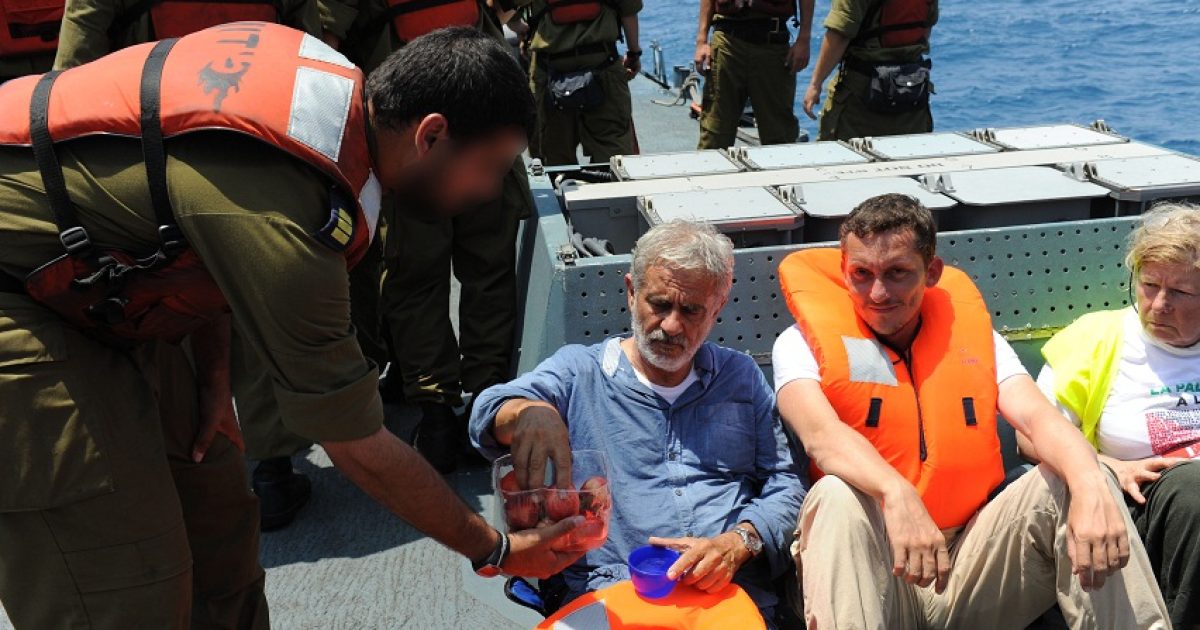

On May 19, 2026, Israeli commandos intercepted all of the more than 50 boats in the flotilla approximately 167 miles from the Gaza coastline, with over 400 activists taken to Israel and brought to Ashdod port.
Israel has maintained a naval blockade on Gaza since 2007, following Hamas’s takeover of the territory. Between October 2025 and May 2026, Israeli forces intercepted four separate flotilla attempts to breach that blockade, detaining and deporting hundreds of activists from across the world.
The first interception came in early October 2025, when the Israeli military dismantled the Global Sumud Flotilla, a 44-vessel fleet. The Polish-flagged Marinette, with a crew of six, was the last vessel seized. Approximately 450 people were arrested in total, including Swedish climate activist Greta Thunberg, Mandla Mandela, and several European lawmakers. Israel later deported all participants.
Days later, on October 8, Israeli forces intercepted a second, smaller flotilla, the Freedom Flotilla Coalition Thousand Madleens mission, named for the Madleen, a vessel intercepted in a solo blockade-breach attempt in June 2025. The flotilla consisted of nine vessels and 145 activists.
A second Global Sumud Flotilla launched in spring 2026. On April 29–30, the Israeli Navy intercepted more than 20 vessels carrying approximately 175 activists in international waters near Crete. Foreign Minister Gideon Sa’ar coordinated with the Greek government to receive the detained participants. Two flotilla organizers, Thiago Ávila and Saif Abu Keshek, were held in Israel for 12 days on suspicion of terrorist affiliation and illegal activity, respectively, before being released without charge.
On May 19, Israeli commandos intercepted all of the more than 50 remaining vessels 167 nautical miles from Gaza, taking over 400 activists to Ashdod port before transferring them to Ketziot prison in the Negev and deporting them via a civilian airport near Eilat. Among those detained was Saad Edhi, grandson of Pakistani philanthropist Abdul Sattar Edhi.
Turkey dispatched planes to retrieve its roughly 85 nationals. Italy, France, the Netherlands, and Canada summoned Israeli ambassadors, while Sweden, Switzerland, Greece, Germany, Poland, Qatar, Slovenia, Turkey, Austria, Belgium, Colombia, and the United Kingdom also condemned the interception; the foreign ministers of Pakistan, Turkey, Bangladesh, Brazil, Colombia, Indonesia, Jordan, Libya, the Maldives, and Spain issued a joint statement condemning the operation.
The Global Sumud Flotilla was organized by a coalition that included the Freedom Flotilla Coalition, the Global Movement to Gaza, the Maghreb Sumud Flotilla, Sumud Nusantara, and the Italian NGO Emergency. The Freedom Flotilla Coalition itself includes national chapters in more than a dozen countries, including Canadian Boat to Gaza, Ship to Gaza Sweden, Rumbo a Gaza Spain, US Boats to Gaza, Palestine Solidarity Alliance South Africa, and Freedom Flotilla Brasil.
The Global Sumud Flotilla is registered as a nonprofit under Spanish law and states that it is funded through crowdfunding and Palestinian diaspora contributions, without government funding. No major institutional donors have been publicly identified.
A formal member of the Freedom Flotilla Coalition is the Turkish IHH Humanitarian Relief Foundation, which Israel designated as a terrorist organization in 2008. IHH is also part of the Union of the Good, an umbrella network of Islamist charities that the U.S. Treasury Department described as “an organization created by Hamas leadership to transfer funds to the terrorist organization.” Germany later banned IHH activities, with the German Interior Ministry stating that the group had, “under the cover of humanitarian aid, supported Gaza Strip-based so-called social associations which are attributable to Hamas.”
France’s former chief anti-terrorism judge, Jean-Louis Bruguière, testified in U.S. federal court that IHH had “clear, long-standing ties to terrorism and Jihad,” including links to a 1999 al-Qaeda plot targeting Los Angeles International Airport. IHH has also been described as a government-organized NGO with close ties to Turkish President Recep Tayyip Erdoğan and the ruling AKP party.
Regarding the broader May 19 detainee pool of more than 400 activists, U.S. Treasury sanctions announced the same day stated that the flotilla’s steering committee included members of the PCPA, which Treasury said was established with Hamas funding and directed by Hamas officials, as well as Samidoun, which the U.S. government designated as a front organization for the PFLP.
Israel’s legal justification for the interceptions rests on the San Remo Manual on International Law Applicable to Armed Conflicts at Sea, which is recognized by the UN, NATO, and international courts as codifying customary naval warfare law. Under the San Remo Manual, a lawful blockade must be publicly declared, applied impartially to ships of all nations, and not intended solely to starve a civilian population.
Israel argues that its blockade meets those criteria, and the 2011 Palmer Report, the UN Secretary-General’s Panel of Inquiry, concluded that the blockade was a legitimate security measure consistent with international law.
A point central to Israel’s legal position is that blockade enforcement is permitted on the high seas, not only at the blockaded coastline. Under the San Remo Manual on International Law Applicable to Armed Conflicts at Sea, a vessel’s declared intention to breach a blockade is itself sufficient legal basis for interception, regardless of the vessel’s distance from shore.
Because a blockade must be enforced impartially, Israel argues that it is legally obligated to intercept all vessels attempting to breach it, including those claiming to carry humanitarian aid.
Israel’s position is that the blockade does not prohibit humanitarian aid from reaching Gaza; it prohibits uninspected maritime entry. Aid may still enter through approved land crossings. The Newport Manual on the Law of Naval Warfare, a 2023 update to the San Remo framework, further states that proportionality is not a consideration for blockades because blockades do not constitute an attack under the laws of armed conflict. Israel has also invoked Article 51 of the UN Charter, which affirms the inherent right of self-defense in response to armed attacks, including attacks carried out by non-state actors.
Critics dispute the legal foundation of the blockade. Flotilla organizers and Amnesty International argue that the blockade constitutes collective punishment prohibited under the Fourth Geneva Convention and that an unlawful blockade cannot create legal rights of interception under the San Remo Manual on International Law Applicable to Armed Conflicts at Sea.
A separate report commissioned by the UN Human Rights Council reached the opposite conclusion of the Palmer Report, finding the blockade disproportionate and therefore illegal. Israel and its legal supporters argue that the Palmer Report, as the UN Secretary-General’s own panel, carries greater authority. The dispute centers less on which legal framework applies and more on whether the underlying blockade itself is lawful, a question on which different UN bodies have reached conflicting conclusions.
The post Gaza Flotilla Interceptions and Arrests Supported by International Law appeared first on The Gateway Pundit.
Go to Source
Author: Antonio Graceffo